The conversation around artificial intelligence in the workplace often defaults to a narrative of replacement and redundancy. Since the arrival of generative AI, headlines have been dominated by speculation about which jobs will disappear and which skills will become obsolete. However, a growing body of research, including significant work from MIT Sloan, presents a more nuanced and optimistic perspective: AI is more likely to complement human workers than replace them, creating a paradox where automation elevates the value of uniquely human capabilities.
This shift is not just theoretical. The World Economic Forum’s 2025 Future of Jobs Report found that whilst AI and big data is the single fastest-growing skill, four of the top five are distinctly human: creative thinking, resilience, curiosity, and leadership [1]. Similarly, McKinsey projects that demand for social and emotional skills will rise by 11-14% by 2030 [2]. The data points to a clear conclusion. As AI handles routine, data-driven tasks, it creates a premium on the complex, contextual, and emotional skills that machines cannot replicate.
Organisations looking to develop these validated human capabilities need measurement systems that go beyond completion certificates to demonstrate actual capability development.
It is within this context that researchers at MIT Sloan developed the EPOCH framework, a powerful tool for understanding the capabilities that will define the future of work. Their research moves beyond identifying jobs at risk and instead asks a more constructive question: ‘What human capabilities complement AI’s shortcomings?’ [3]. The answer provides a clear roadmap for individuals and organisations looking to thrive in an AI-augmented world.
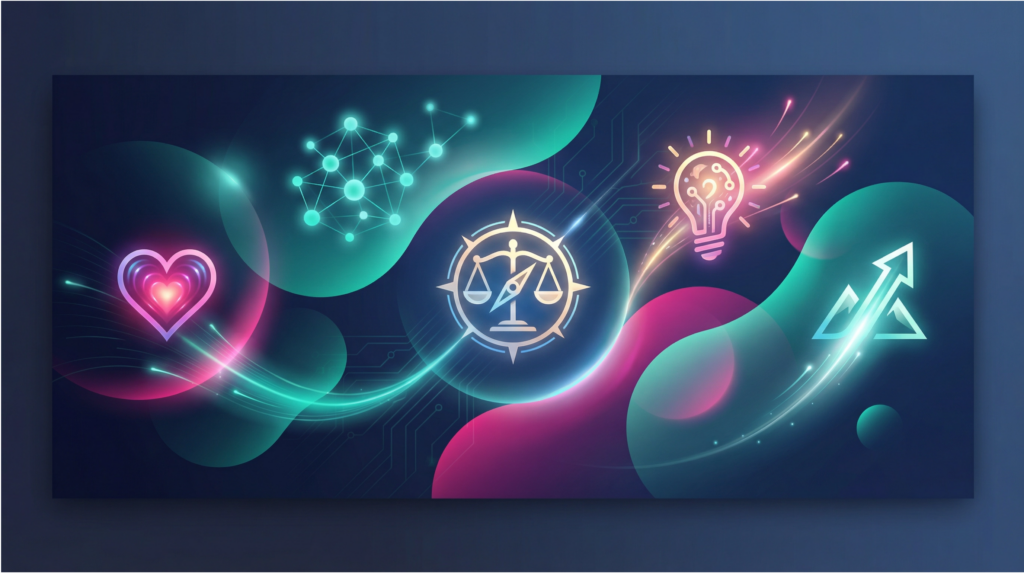
Introducing the EPOCH Framework
Developed by MIT Sloan postdoctoral associate Isabella Loaiza and Professor Roberto Rigobon, the EPOCH framework identifies five groups of human capabilities that AI struggles to replicate [4]. The acronym stands for Empathy, Presence, Opinion, Creativity, and Hope. By analysing nearly 19,000 work tasks from the U.S. Bureau of Labor Statistics’ O*NET database, the researchers were able to map which tasks relied on these human-centric skills and track their relationship with employment growth between 2016 and 2024.
The findings were significant. Not only were all five EPOCH capabilities associated with employment growth, but tasks newly added to the database in 2024 showed higher levels of these capabilities than the tasks that had disappeared. This provides strong evidence for what the researchers call a ‘shift towards a more human-intensive work’ [3].
This kind of rigorous, evidence-based approach is exactly what HR and L&D directors need when moving from completion tracking to department-level analytics that demonstrate real capability development.
Let’s explore each of the five capabilities in detail.
1. Empathy and Emotional Intelligence (E)
Whilst AI can be trained to recognise and respond to human emotions, it cannot genuinely share an emotional experience or build a meaningful connection. Empathy, the ability to understand and share the feelings of another, remains a deeply human trait. It is the foundation of effective collaboration, client relationships, and compassionate leadership.
“AI may be able to detect emotions, but humans can create a meaningful connection and share what the person is experiencing,” the researchers note [3].
This capability is critical in professions like social work, healthcare, and education, where building trust and rapport is paramount. As AI automates administrative tasks in these fields, the human element of care and connection becomes even more central to the role’s value.
2. Presence, Networking, and Connectedness (P)
The EPOCH framework acknowledges the importance of physical presence in building relationships and fostering innovation. Whilst remote work and digital communication have their place, the spontaneous interactions, shared understanding, and collaborative energy that come from being physically present are difficult to replicate virtually and almost impossible for an AI to simulate.
Occupations such as nursing, journalism, and frontline leadership demonstrate the power of presence. A nurse’s comforting hand, a journalist’s ability to build trust with a source on the ground, or a manager’s visibility on the factory floor all rely on a physical presence that goes beyond mere data exchange.
3. Opinion, Judgment, and Ethics (O)
AI systems are powerful tools for analysis, but they operate within the closed systems of their training data. They struggle with open-ended problems, moral dilemmas, and situations that require a deep understanding of context, accountability, and responsibility. This is the realm of human opinion and judgment.
Humans can navigate ambiguity and make decisions based on principles, values, and a long-term vision that may even contradict the immediate data. The researchers cite historical movements like women’s suffrage and civil rights as examples where conviction and belief defied the prevailing status quo [3].
As Loaiza explains, “[Humans sometimes] make decisions not because the data tells us it is possible but because, out of principle, it should be done” [3].
This capability is the cornerstone of the legal profession, scientific discovery, and strategic leadership. The research found that this ‘Opinion’ capability was the second-largest driver of employment growth, underscoring its increasing importance. This is why our Human Skills Index prioritises decision-making under pressure as one of eight core capabilities, placing individuals in high-stakes business scenarios where they must navigate ambiguity and make judgment calls with incomplete information.
4. Creativity and Imagination (C)
Generative AI can produce impressive text, images, and code, but it does so by remixing and reconfiguring existing data. True creativity, the ability to generate genuinely novel ideas and visualise possibilities beyond the scope of current reality, remains a human domain. This includes humour, improvisation, and the kind of divergent thinking that leads to disruptive innovation.
This capability is, of course, vital in design and the arts, but it is equally important in scientific research and entrepreneurship. It is the spark that allows a scientist to formulate a new hypothesis or an engineer to devise a completely new solution to an old problem.
5. Hope, Vision, and Leadership (H)
The final capability in the framework is perhaps the most profoundly human. Hope, vision, and leadership encompass the grit, perseverance, and initiative required to pursue ambitious goals, often in the face of long odds. It is the entrepreneur starting a new venture or the leader guiding an organisation through a period of profound change.
AI can optimise processes and predict outcomes based on historical data, but it cannot inspire a team, build a culture, or take a principled stand for a better future. The MIT research found that this ‘Hope’ capability was the single largest driver of employment growth, a powerful indicator of its value in the modern economy. This is particularly relevant for team managers who need to develop leadership capabilities across their teams, not just in designated leadership roles.
From MIT Framework to Your Organisation Capabilities
The EPOCH framework provides a robust, academic validation for the importance of human skills. More importantly, it offers a clear model for which capabilities to prioritise. When we cross-reference the EPOCH framework with our own Human Skills Index, the alignment is striking. Four of the five EPOCH capabilities map directly to the eight capabilities we measure and develop.
| MIT EPOCH Capability | Our Human Skills Index Capability | Alignment |
| Empathy | Team Collaboration | Direct Match |
| Opinion / Judgment | Decision-Making | Direct Match |
| Creativity | Problem Solving | Strong Match |
| Hope / Leadership | Leadership | Direct Match |
This is not a coincidence. Our framework was built from the ground up based on what employers, from the CBI to the World Economic Forum, have consistently identified as the most critical skills for workplace success [5]. The fact that MIT’s independent research, starting from the limitations of AI, arrived at the same conclusions is a powerful validation of this approach. To understand how we measure and validate these capabilities through applied business simulation rather than self-assessment, explore our methodology.
- Empathy and Team Collaboration: MIT’s ‘Empathy’ is the core of our Team Collaboration capability. Our simulations measure and develop a participant’s ability to understand team dynamics, build consensus, and communicate effectively, all of which are predicated on understanding the perspectives of others.
- Opinion and Decision-Making: The ‘Opinion and Judgment’ capability is a perfect match for our Decision-Making capability. We move beyond theoretical knowledge by placing individuals in simulations where they must make complex, high-stakes decisions with incomplete information, measuring the quality and impact of their judgment under pressure.
- Creativity and Problem Solving: MIT’s ‘Creativity’ aligns strongly with our Problem Solving capability. We assess an individual’s ability to analyse complex situations, identify novel solutions, and adapt their approach when faced with unexpected challenges, mirroring the creative process in a commercial context.
- Hope and Leadership: The ‘Hope, Vision, and Leadership’ capability is directly reflected in our Leadership capability. Our simulations evaluate a user’s ability to inspire a team, manage stakeholders, and drive a strategic vision forward, even when faced with setbacks.
Measuring EPOCH Capabilities in Practice
Understanding which capabilities matter is only the first step. The challenge for organisations is moving from conceptual frameworks to measurable development. Traditional training approaches struggle here because they measure knowledge acquisition rather than applied capability.
Skills Hub Workforce addresses this by placing individuals in realistic business scenarios where they must demonstrate judgment, creativity, collaboration, and leadership under pressure. Each decision, each strategic choice, and each stakeholder interaction contributes to a 0-100 capability score that tracks development over time.
For HR and L&D teams, this means moving from ‘completed 15 courses’ to ‘leadership capability increased from 62 to 78 across the sales department.’ For team managers, it means identifying capability gaps and tracking development with data rather than intuition. For training providers, it means adding proof of impact to training programmes that previously relied on completion certificates.
The Future is Human-Centric
The rise of AI does not signal the end of human value in the workplace. On the contrary, it clarifies what it means to be human at work. The research from MIT Sloan provides a compelling, evidence-based framework for understanding this new reality. The capabilities that AI cannot replicate—Empathy, Presence, Opinion, Creativity, and Hope—are not ‘soft skills’. They are the essential, measurable, and developable capabilities that will drive individual careers and organisational success for decades to come.
By focusing on measuring and developing these validated human capabilities, we can move the conversation from fear of replacement to a confident strategy of augmentation. The future of work is not about humans versus machines. It is about equipping humans with the skills to do what machines cannot, and to do it better than ever before. For organisations ready to move beyond completion tracking, implementing a capability measurement system starts with understanding your current baseline and identifying development priorities.
Ready to build the capabilities that matter?
Explore how the Human Skills Index aligns with the frameworks that define the future of work:
For HR & L&D Directors: See how department-level analytics prove L&D ROI
For Team Managers: Discover how to develop your team’s capabilities in 20 minutes, not 2 days
For Training Providers: Learn how to add measurable capability development to your training programmes
References
- [1] World Economic Forum. (2025). Future of Jobs Report 2025. https://www.weforum.org/reports/future-of-jobs-report-2025/
- [2] McKinsey Global Institute. (2024). A New Future of Work. https://www.mckinsey.com/mgi/our-research/a-new-future-of-work
- [3] Eastwood, B. (2025, June 10). These human capabilities complement AI’s shortcomings. MIT Sloan. https://mitsloan.mit.edu/ideas-made-to-matter/these-human-capabilities-complement-ais-shortcomings
- [4] MIT Sloan School of Management. (2025, March 17). New MIT Sloan research suggests that AI is more likely to complement, not replace, human workers. https://mitsloan.mit.edu/press/new-mit-sloan-research-suggests-ai-more-likely-to-complement-not-replace-human-workers
- [5] Enterprise Skills. (2026). The Human Skills Index Framework. https://www.enterpriseskills.com/human-skills-index/framework/